New acquisitions
Oil painting by Caspar Benedikt Beckenkamp:
Equestrian portrait of Kunigunde of Saxony, Princess-Abbess of Essen (ca. 1770–1779)
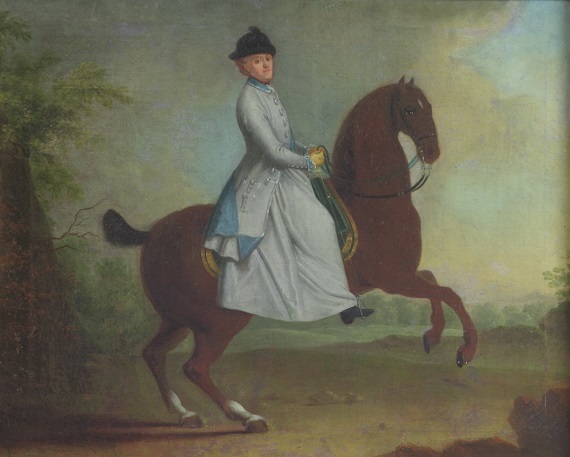
The painting depicts Kunigunde of Saxony, the sister of Elector Clemens Wenzeslaus, on horseback in hunting attire. The painting exists in three versions. First, Beckenkamp painted a large version, which still hangs today at Bürresheim Castle. In this large version, the electoral castle of Kärlich—which was destroyed during the Napoleonic era—can still be seen in the background.
In addition, Beckenkamp painted two smaller copies of the painting. One hung in the Mittelrhein Museum until World War II but was lost at the end of the war. The third version, shown here, was in private hands and was donated to the Mittelrhein Museum just this year. The painting complements the Ehrenbreitstein marksmen’s silver on display perfectly, as Kunigunde was an outstanding huntress and markswoman; she herself became the marksmen’s queen in Ehrenbreitstein.
The painter Beckenkamp (born in Ehrenbreitstein, 1747–1828, Cologne) received his early training from his father, Laurenz Beckenkamp (1704–1762), court painter in Ehrenbreitstein; later, he worked under Januarius Zick in Ehrenbreitstein and with Christian Georg Schütz the Elder (1718–1791) in Frankfurt. From 1781 to 1784, he was back in Ehrenbreitstein; following the early death of his wife, he lived in Bonn from 1785 to 1794 and moved to Cologne in 1794, where he remained until his death.
Beckenkamp worked primarily as a portrait painter, finding his clients among the nobility and the upper middle class.
(Text: Dr. Matthias von der Bank, Mittelrhein Museum, Koblenz)
New acquisition by the association: reconstruction of a historical ladies‘ dress based on designs from the second half of the 18th century

Maria Magdalena van Beethoven loved beautiful dresses and owned an elegant wardrobe. At least, that is how Cäcilie Fischer (1762-1845) remembered it, having lived in the same house as her for many years and been in close contact with her and her family.
This fact inspired the friends and supporters of the Mutter-Beethoven-Haus to commission the reconstruction of a festive dress that would correspond to those owned by Beethoven’s mother.
Dr. Beate Marks-Hanßen, Purpurvilla, Bonn, was responsible for making the dress, the undergarments, and the bonnet. She based her work on depictions from Bonn and Koblenz that were created in the second half of the 18th century—such as a portrait of Anna Ries, who was married to Ludwig van Beethoven’s violin teacher. A silhouette showing Helene and Eleonore von Breuning and a portrait of Jakob von Düsseldorf’s wife, which can be seen in the basement of the museum, also served as models.
The ensemble created in this way and exhibited in the Mutter-Beethoven-Haus museum consists of a dress in the style of the so-called “robe à l’anglaise” (English-style dress), as worn by ladies of the nobility and upper middle class during Maria Magdalena van Beethoven’s lifetime, and an organza bonnet with large bows and satin ribbons.
But it is not only the outer garment that corresponds to historical models from the second half of the 18th century; the undergarments do too. A bodice (laced bodice) and two voluminous petticoats were worn over a shirt. And a special feature of the “Robe à l’anglaise,” the “Cul de Paris” (i.e., the puffing up of the dress at the back of the body by means of two pads worn under the skirts), was not omitted either. However, these garments can only be seen during special presentations at the museum.
(HERE further information on the new acquisition)

Baroque house in Ehrenbreitstein (Helfensteinstr. 86 /corner Humboldtstr.) Former house of the composer and church musician Josef Buschmann (1893–1966). Oil, middle of 19th century, later mounted on hardboard 18 x 24 cm. Auctioned by M. Diehl at auction house Lux, Koblenz, 17 and 18/3/2023, starting price: €80,00.
Middle Rhine Museum Koblenz – Inv.-no.: still missing
(permanent loan from the sponsors of the Mother Beethoven House)
HERE you can find more new exhibits.